One ignored Mailchimp form cost me $1,271
TL;DR enable reCAPTCHA
Who amongst us hasn’t promised to send a regularly scheduled newsletter only to lose steam after a few sends?
No big deal. Except! when your email subscriber form is hooked up to a service that charges based on the number of contacts in your database.
How one forgotten form became my very expensive mistake
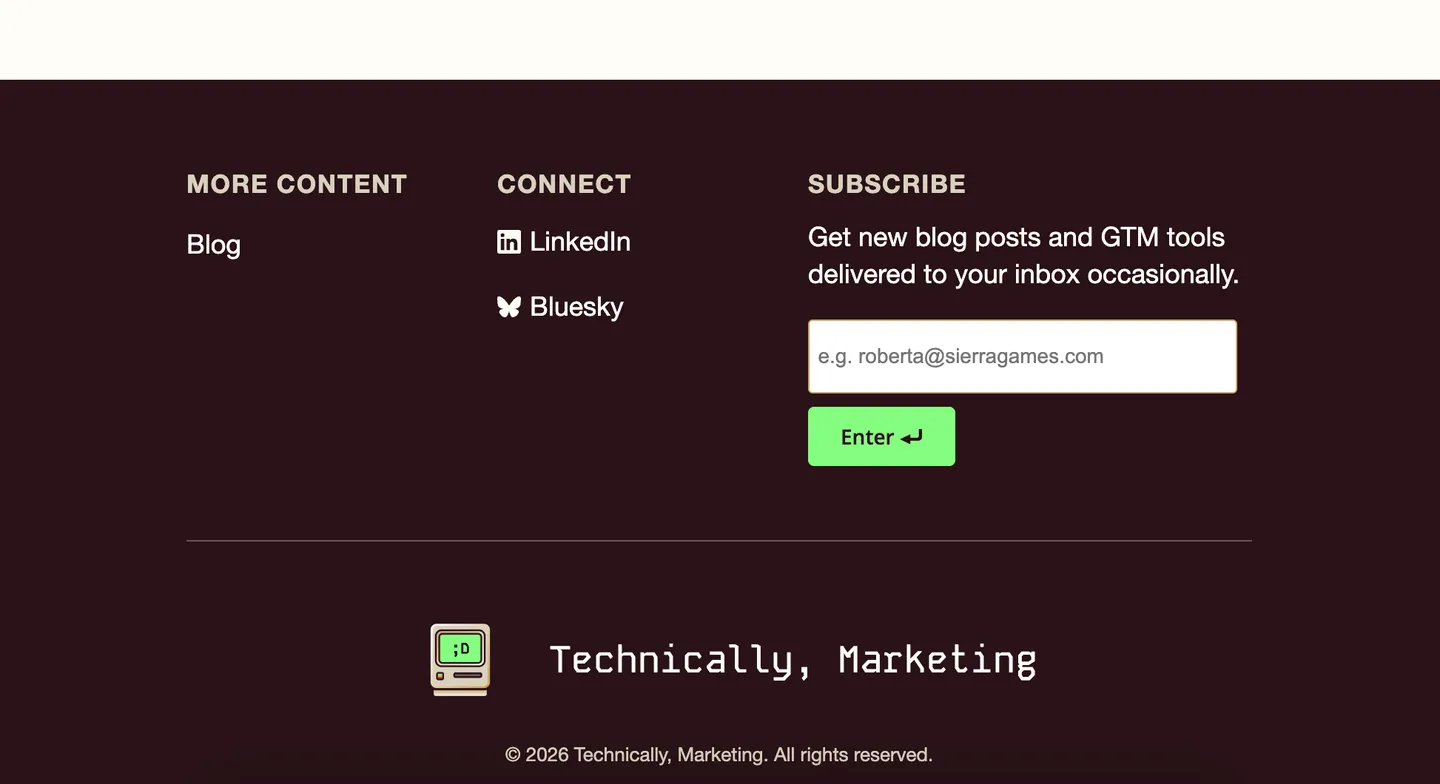
Down in the footer at the bottom of my work website, I have a little email capture form that sends subscribers to Mailchimp.
Like many email services and CRMs, Mailchimp charges you monthly based on the number of contacts you have in your database. What’s more: if you happen to accumulate more contacts than your current plan allows, they charge you overages until you manually upgrade your plan. This mechanism is there to incentivize people to buy more robust features as their Audience size grows.
But my website hardly gets any traffic. Surely I won’t stockpile that many email subscribers.
Wrongzo.
Despite hardly ever promoting my site, despite zero ads or backlinks, I managed to passively attract more than 2,500 contacts over 18 months.
When I first signed up for my Mailchimp plan I was paying $20 per month. Today, purely out of neglect, that same plan costs $117.50 with overage fees. The SaaS login is 5× more expensive to hang onto, even though I haven’t sent a single email this year. Yikes!
Throwing all that cash down the drain stings. But what hurts more than pouring hot honey into an open wound? 92% of the contacts in my account aren’t even humans.
Dead email list theory
You’ve heard of Dead Internet Theory, how there’s more bot traffic than human traffic on the web. At this point we’ve flipped so hard we’re full-on embracing the agent experience. It’s okay if all our site traffic is bots and crawlers as long as there’s a human controlling the harness.
Spambot email signups aren’t in the same category as agentic web traffic. These aren’t agents trying to scrape site content for AI overview results or OpenClaw assistants collating information for busy professionals. Spambot email signups happen because it’s a cheap way to exploit infrastructure, find giveaways, or maliciously muck up your deliverability.
Of all the bot emails on my newsletter subscription list:
- 102 of them were from suspicious domains
- 156 had a Gmail dot-padding pattern
- 2 were SMS text gateways
Then, of the ~2,300 emails that superficially look like they could belong to real people, 60% of those signups came from IPs outside of the United States, Canada and Europe. The heaviest traffic spikes were from Brazil, Cambodia, Vietnam, Indonesia, South Africa and Bangladesh.
Look, I’d love to earn a global audience one day. But for right now, I’m pretty suspicious of any traffic spikes coming from Jakarta.
When I filter the list by domains, I see a few problems:
- 8% of the custom domain emails are attached to expired DNS, sites that don’t resolve at all
- Many emails seem to be attached to legit domains but employees who no longer work at those companies, big companies like Pfizer, Bonne Maman jams
- More emails belong to domains for small businesses selling products that aren’t relevant to my services; I’m a growth marketer for tech companies; I can’t help you sell more tractor parts, automobiles, or yachts
”Babe, did you not have reCAPTCHA enabled?”
Of course I didn’t have reCAPTCHA enabled. But, you bet your butt it’s turned on now!
Finding the humans
At a glance, I can see at least 20 people on my email subscriber list who are legit subscribers. I recognize their emails right away because I’ve worked with them before, met them for coffee, or chatted with them over Zoom.
If there are any new genuine leads for my business hiding in this CSV, they’d be expensive to find. I could use an enrichment service, like Clay which costs $185 per month, but it would be like panning for gold with a platinum sieve.
So, I did the next best thing. I sent a re-permission email.
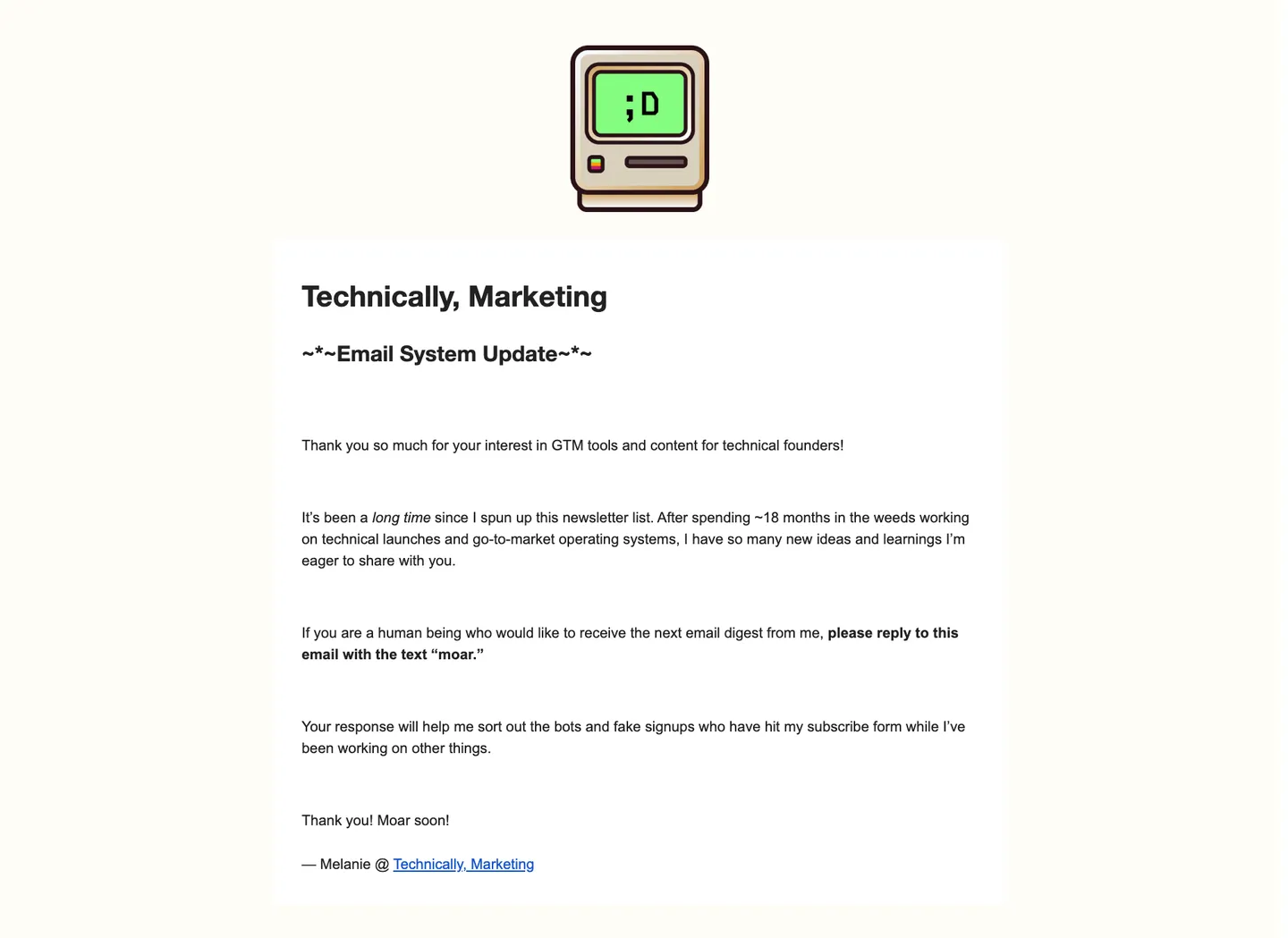
If you’re one of the handful of lovely people who took the time to write back “moar!” this morning, thank you! You have made my day. I’ll be in touch soon.
Buying time to build what’s next
Now that I have a better handle on my genuine list size, I need to stop the bleeding.
The easiest, fastest solution is: remove the form from my website footer, export my Audience as .csv and pause my Mailchimp account. This punts my problem down the road until I’ve got valuable content ready to send. It also buys me time to go shopping for a cheaper ESP.
But, where to next?
The new world of email sending providers breaks down into two categories: for businesses and for people.
Within the category of email sending providers for people, there are two flavors: traditional ESPs and new creator-oriented platforms like Substack and Beehiiv that want to own your subscriber base, your content and your community.
I’m not considering Substack, for all of the reasons outlined at leavesubstack.com.
However, Beehiiv’s pricing is attractive at free ninety-nine for up to 2,500 subscribers (more than enough). The tradeoff is a newsletter that works more like a public archive website than a private email list.
Maybe that’s okay?
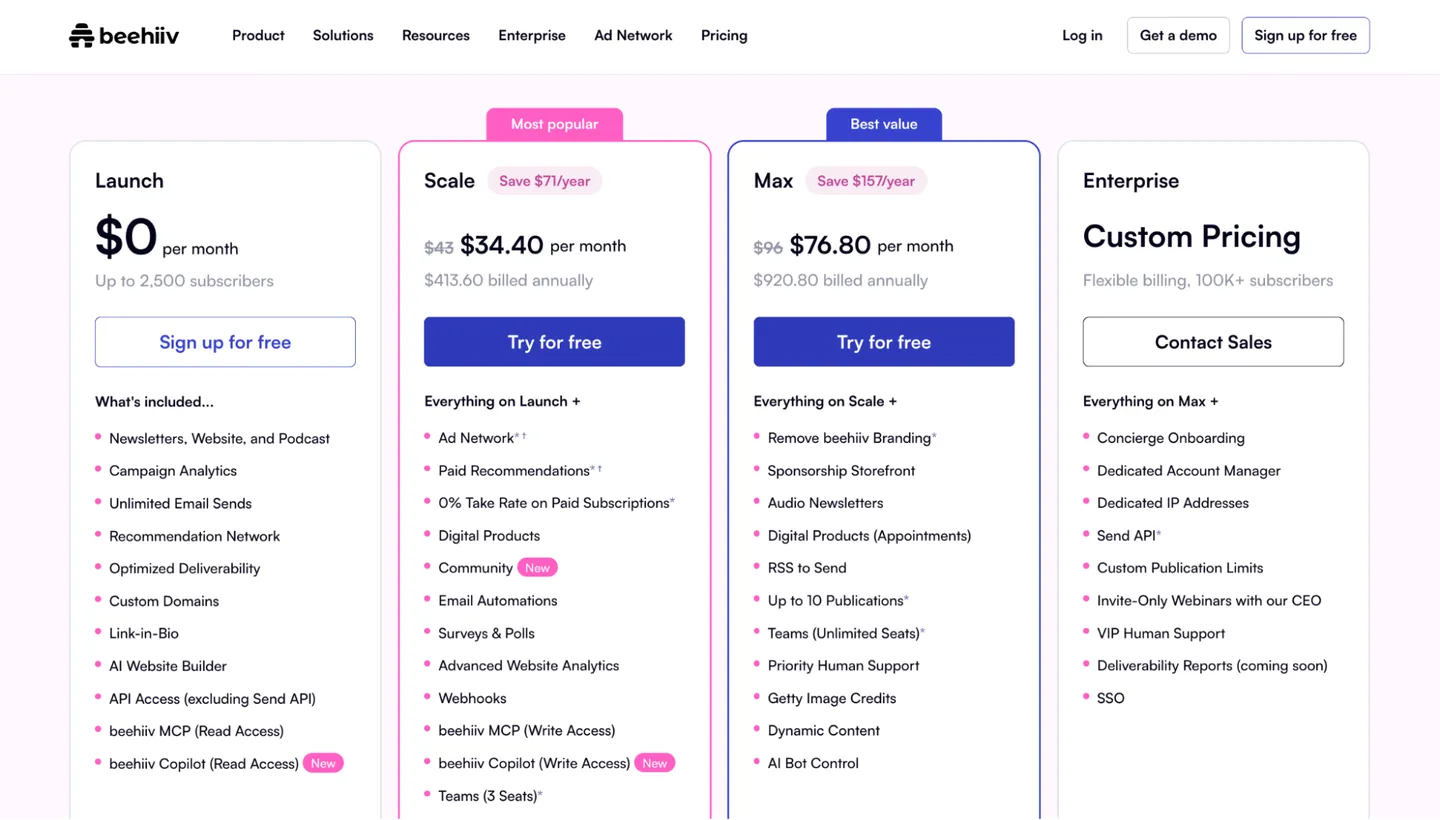
As somebody who remembers the rise and fall of Medium, I’m leery of modern platforms that want to host my content. I’d prefer to pretend what’s in my GitHub repo is mine.

But as a marketer, I’m curious about the potential upside of joining a buzzy platform. Network effects? Paid subscriptions? Perhaps some sturdier spam detection built-in?
It’s trite to say out loud but communities are everything.
The podcasters know it. The dev rel folks know it.
A small number of relationships with verified people is infinitely more valuable than a million anonymous impressions or thousands of email addresses that must be enriched, qualified, and squeezed down a funnel.
Unfortunately I am busy today and I need to set this problem down for now. Until next time:
Don’t pay the idiot tax. Turn on your reCAPTCHA. Stay safe out there.
Author’s note: It’s quite embarrassing to accidentally waste $1,200 on a dormant Mailchimp account, but I have no room to complain. I’m sure Mailchimp spent more money on my drink tabs at various Mailchimp Proms over the years. RIP the good times.
Also: Should you find yourself in a similar “oops I was too optimistic about the chances I’d send an email this month and now I’m lighting money on fire” situation, Mailchimp has an option to PAUSE your account for up to 6 months. You just have to brute force past the full-screen upgrade modal to reach that setting.